

Search

As your logistics partner, we are committed to keeping you informed about the latest trade policy changes that may impact your business across North America.
Recent announcements in both the United States and Canada include new tariffs and updated duty regulations that could affect a wide range of imports. Below, we have summarized the key points and provided links to the official fact sheets for your convenience.
Please reach out to your assigned Gebrüder Weiss representative should you have any questions or concerns.
We are writing to alert you to a significant escalation in U.S.–Canada trade measures. Beginning September 29, 2026, certain Canadian-origin goods will no longer be subject to a duty — they will be banned from entry into the United States altogether.
What Changed
On September 8, 2026, the President signed three new proclamations (Nos. 11061, 11062, and 11063) under Section 338 of the Tariff Act of 1930, excluding specified Canadian products from importation entirely. This is a separate and more severe action than the 50% Section 338 additional duties that took effect August 22, 2026, and were later expanded on September 15, 2026.
Effective 12:01 a.m. Eastern Time on September 29, 2026, covered goods of Canadian origin cannot be entered into the United States — at any duty rate. This is an outright prohibition, not a tariff increase.
CBP Guidance Issued To Date
What Is Banned (68 HTS Lines Total)
The ban covers three categories: 53 lines of alcoholic beverages, 14 lines of whey/molasses/non-alcoholic beer, and 1 line covering motorcycles over 800cc. Note that for 28 of the 53 alcohol lines, the ban applies only to packaged product (bottles, cans, kegs, boxes for direct consumption) — bulk product under those same lines remains subject to the 50% duty rather than the ban. Lines marked “Entire line” are banned regardless of packaging.
Category 1: Alcoholic Beverages (53 lines) — Proclamation 11061
| HTS Code | Product Description | Ban Scope |
|---|---|---|
| 2203.00.00 | Beer made from malt | Packaged only |
| 2204.10.00 | Sparkling wine | Packaged only |
| 2204.21.20 | Other wine; effervescent, in containers ≤ 2 liters | Entire line |
| 2204.21.30 | Other wine; "Tokay" designation, ≤ 14% vol, ≤ 2 liters | Entire line |
| 2204.21.50 | Other wine; ≤ 14% vol, ≤ 2 liters | Entire line |
| 2204.21.60 | Other wine; "Marsala" designation, >14% vol, ≤ 2 liters | Entire line |
| 2204.21.80 | Other wine; >14% vol, ≤ 2 liters | Entire line |
| 2204.22.20 | Other wine; ≤ 14% vol, 2–4 liter containers | Entire line |
| 2204.22.40 | Other wine; >14% vol, 2–4 liter containers | Entire line |
| 2204.22.60 | Other wine; ≤ 14% vol, 4–10 liter containers | Packaged only |
| 2204.22.80 | Other wine; >14% vol, 4–10 liter containers | Packaged only |
| 2204.29.61 | Other wine; ≤ 14% vol | Packaged only |
| 2204.29.81 | Other wine; >14% vol | Packaged only |
| 2205.10.30 | Vermouth, containers ≤ 2 liters | Entire line |
| 2206.00.15 | Cider, still or sparkling | Packaged only |
| 2206.00.30 | Prune wine | Packaged only |
| 2206.00.45 | Rice wine or sakè | Packaged only |
| 2206.00.60 | Effervescent wine (fermented beverage) | Packaged only |
| 2206.00.90 | Other fermented beverages, other | Packaged only |
| 2207.10.30 | Undenatured ethyl alcohol ≥80% vol, for beverage purposes | Packaged only |
| 2208.20.10 | Pisco and singani (grape brandy) | Packaged only |
| 2208.20.20 | Grape brandy, ≤4L containers, value ≤$2.38/L | Entire line |
| 2208.20.30 | Grape brandy, ≤4L containers, value $2.38–$3.43/L | Entire line |
| 2208.20.40 | Grape brandy, ≤4L containers, value >$3.43/L | Entire line |
| 2208.20.50 | Grape brandy, >4L containers, value ≤$2.38/L | Packaged only |
| 2208.20.60 | Grape brandy, >4L containers, value >$2.38/L | Packaged only |
| 2208.30.30 | Irish and Scotch whiskies | Packaged only |
| 2208.30.6020 | Bourbon, ≤4L containers | Entire line |
| 2208.30.6040 | Bourbon, >4L containers | Packaged only |
| 2208.30.6055 | Rye whiskey, ≤4L containers | Entire line |
| 2208.30.6065 | Whiskies, ≤4L containers (other) | Entire line |
| 2208.30.6075 | Rye whiskey, >4L containers | Packaged only |
| 2208.40.20 | Rum/sugar-cane spirits, ≤4L, ≤$3/proof liter | Entire line |
| 2208.40.40 | Rum/sugar-cane spirits, ≤4L, >$3/proof liter | Entire line |
| 2208.40.60 | Rum/sugar-cane spirits, >4L, ≤69¢/proof liter | Packaged only |
| 2208.40.80 | Rum/sugar-cane spirits, >4L, >69¢/proof liter | Packaged only |
| 2208.50.00 | Gin and Geneve | Packaged only |
| 2208.60.10 | Vodka, ≤4L containers, value ≤$2.05/L | Entire line |
| 2208.60.20 | Vodka, ≤4L containers, value >$2.05/L | Entire line |
| 2208.60.50 | Vodka, >4L containers | Packaged only |
| 2208.70.0030 | Liqueurs and cordials, ≤4L containers | Entire line |
| 2208.90.10 | Bitters, fit for beverage use | Packaged only |
| 2208.90.12 | Slivovitz, ≤$3.43/L, ≤4L containers | Entire line |
| 2208.90.14 | Slivovitz, ≤$3.43/L, >4L containers | Packaged only |
| 2208.90.15 | Slivovitz, >$3.43/L | Packaged only |
| 2208.90.20 | Brandy, ≤4L containers, ≤$2.38/L | Entire line |
| 2208.90.25 | Brandy, ≤4L containers, $2.38–$3.43/L | Entire line |
| 2208.90.30 | Brandy, ≤4L containers, >$3.43/L | Entire line |
| 2208.90.35 | Brandy, >4L containers, ≤$2.38/L | Packaged only |
| 2208.90.40 | Brandy, >4L containers, >$2.38/L | Packaged only |
| 2208.90.50 | Tequila, ≤4L containers | Entire line |
| 2208.90.72 | Mezcal, ≤4L containers | Entire line |
| 2208.90.75 | Other spirits | Packaged only |
Category 2: Whey, Molasses & Non-Alcoholic Beer (14 lines) — Proclamation 11062
| HTS Code | Product Description | Ban Scope |
|---|---|---|
| 0404.10.05 | Modified whey – whey protein concentrates | Entire line |
| 0404.10.08 | Modified whey – GN 15 provisions | Entire line |
| 0404.10.11 | Modified whey – Add'l U.S. Note 10 provisions | Entire line |
| 0404.10.15 | Modified whey (other) | Entire line |
| 0404.10.20 | Fluid whey | Entire line |
| 0404.10.48 | Dried whey – GN 15 provisions | Entire line |
| 0404.10.50 | Dried whey – Add'l U.S. Note 12 provisions | Entire line |
| 0404.10.90 | Dried whey (other) | Entire line |
| 1702.90.35 | Invert molasses (cane/beet sugar derived) | Entire line |
| 1703.10.30 | Cane molasses – for sugar extraction or human consumption | Entire line |
| 1703.10.50 | Cane molasses (other) | Entire line |
| 1703.90.30 | Molasses – for sugar extraction or human consumption | Entire line |
| 1703.90.50 | Molasses (other) | Entire line |
| 2202.91.00 | Non-alcoholic beer | Entire line |
Category 3: Motorcycles Over 800cc (1 line) — Proclamation 11063
| HTS Code | Product Description | Ban Scope |
|---|---|---|
| 8711.50.00 | Motorcycles/cycles, internal combustion, >800cc | Entire line |
Transition Rule — Goods Already in Transit
Covered goods that were imported, but not yet entered for consumption or withdrawn from warehouse for consumption, before September 29, 2026 remain subject to the existing 50% Section 338 duty rather than the new ban. The controlling factor is the entry date on your CBP paperwork — not the ship date or arrival date.
What This Means for You
If you import any of the products listed above from Canada, entries filed on or after September 29, 2026 for these HTS lines will be rejected outright — there is no duty rate, however high, that will allow entry. USMCA origin does not provide an exemption from either the underlying 50% duty or this new ban.
Recommended Next Steps
Please Note: This is a fast-moving, still-developing situation. CBP has not yet published implementing guidance (CSMS) for the September 29 bans, so operational details — particularly for goods in transit, bonded warehouses, and foreign-trade zones — remain unconfirmed. Drawback treatment for banned goods is also unresolved; banned goods cannot be entered and therefore cannot generate drawback under current guidance. We will send a follow-up the moment CBP issues further instructions.
We're Here to Help
Our trade compliance team is tracking this issue closely. Please reach out to your GW account representative to discuss any questions you may have.
A new U.S. tariff-rate quota directly affects the cost of importing certain quartz surface products into the United States. Effective August 15, 2026, the measure applies to products such as quartz countertops, flooring, backsplashes, tiles, and similar surfaces imported from most countries.
What happened?
On July 31, 2026, President Trump signed a new law called a Section 201 Safeguard, which puts a new extra tariff on quartz surface products coming into the United States from most countries. The rules were officially published on August 5, 2026 (Federal Register FR 2026-15975 / 91 FR 50645), and U.S. Customs issued the official Quota Bulletin QB-26-601-2027 on August 12, 2026.
The new tariff started on August 15, 2026 at 12:01 a.m. Eastern Time. This means any quartz shipment that arrived at a U.S. port on or after that date and time is now subject to this new tariff — even if you ordered or shipped the goods before that date.
How does the quota work?
Think of the quota as a bucket that fills up each quarter. While there is room in the bucket, importers pay the lower in-quota tariff rate. Once the bucket is full, subsequent imports are subject to the higher above-quota tariff rate for the remainder of that quarter.
There are therefore two possible tariff rates, depending on whether the quarterly limit has been reached:
| In-Quota (Lower Rate) | Over-Quota (Higher Rate) | |
|---|---|---|
| HTS Code | 9903.45.30 | 9903.45.31 |
| When it applies | While the quarterly volume limit has not been reached | Once the quarterly volume limit has been reached |
What are the rates?
| Period | In-quota tariff rate (9903.45.30) | Above-quota tariff rate (9903.45.31) | Annual Volume |
|---|---|---|---|
| Year 1: August 15, 2026 - August 14, 2027 | 25% | 50% | 13,006,426 m2 |
| Year 2: August 15, 2027 - August 14, 2028 | 20% | 45% | Increases |
| Year 3: August 15, 2028 - August 14, 2029 | 15% | 40% | Increases |
| Year 4: August 15, 2029 - August 14, 2030 | 10% | 35% | Increases |
Important: These rates are in addition to other applicable tariffs and duties. Depending on the product and country of origin, these may include regular customs duties, China Section 301 tariffs, antidumping and countervailing duties, and Section 301 forced labor-related tariffs. All applicable duty layers must be considered when calculating the total landed cost.
Quarterly schedule for Year 1 (August 15, 2026 - August 14, 2027)
The annual quota is split into four equal quarters. Each quarter has its own volume limit of 3,251,606 square meters plus any unused rollover from the previous quarter.
| Quarter | Start Date | End Date |
|---|---|---|
| Q1 | August 15, 2026 | November 14, 2026 |
| Q2 | November 15, 2026 | February 13, 2027 |
| Q3 | February 14, 2027 | May 15, 2027 |
| Q4 | May 16, 2027 | August 14, 2027 |
How timing works: The quota opens at 12:01 a.m. local port time at the beginning of each quarter. However, entries submitted before 8:30 a.m. Eastern Time on the opening date receive the same presentation time of 8:30 a.m. If the total volume presented exceeds the available quota, entries are allocated proportionally. This means that only part of a shipment may qualify for the lower in-quota rate.
Which products are covered?
If you import any of the following quartz surface products, this quota applies to you:
The covered HTS codes from Chapters 68 and 70 are: 6810.99.0020, 6810.99.0040, and 7020.00.6000.
Which countries are excluded?
Not all countries are subject to this quota. The following countries are EXCLUDED and their quartz products do NOT count toward the quota limits:
Quartz surface products originating in an excluded country are not currently subject to this tariff-rate quota and do not count toward its limits. However, other tariffs and duties may still apply, and exclusions may be modified under the terms of the Proclamation.
Please contact your Gebrüder Weiss trade compliance representative to confirm the treatment of your specific products and country of origin.
How Gebrüder Weiss can help
Our team can help determine whether your products are affected by the quota and ensure that customs entries are filed using the appropriate HTSUS codes and quota subheadings. We can also advise on entry timing, monitor quarterly quota fill levels, and assist with any corrections required for entries filed around the August 15 effective date.
Please contact your Gebrüder Weiss account representative if you have questions or would like to discuss the potential impact on your imports.
We are reaching out today with an important trade compliance update that may significantly impact your import costs and supply chain planning.
The U.S. Department of Commerce Bureau of Industry and Security (BIS) continues to aggressively expand the scope of Section 232 national security tariffs well beyond their original application on steel and aluminum. There are currently eleven active Section 232 investigations underway — any one of which could result in new tariffs imposed with little advance notice once Commerce submits its report to the President.
SECTION 232 ACTIVE INVESTIGATION WATCH LIST
The following product categories are currently under active Section 232 national security investigation by the Department of Commerce. These investigations are completed within 270 days of initiation, meaning several are at or approaching the point where Presidential action can be taken at any time.
| Product Category Under Investigation | Date Initiated | Status |
|---|---|---|
| Anthracite Coal | June 29, 2026 | Newest — Active |
| Robotics and Industrial Machinery | September 2, 2025 | Active — Report due ~May 2026 |
| Personal Protective Equipment, Medical Consumables & Medical Devices | September 2, 2025 | Active — Report due ~May 2026 |
| Wind Turbines and Their Parts | August 13, 2025 | Active |
| Unmanned Aircraft Systems (UAS) and Parts & Components | July 1, 2025 | Active |
| Polysilicon and Derivative Products | July 1, 2025 | Active |
| Commercial Aircraft and Jet Engines | May 1, 2025 | Active |
| Processed Critical Minerals and Derivative Products | April 22, 2025 | Active |
| Medium- & Heavy-Duty Trucks, Parts and Buses | April 22, 2025 | Active |
| Pharmaceuticals & Pharmaceutical Ingredients | April 1, 2025 | Tariffs Effective July 31/Sep 29, 2026 |
| Semiconductors & Semiconductor Manufacturing Equipment (SME) | April 1, 2025 | Active |
Note: The investigation into Robotics and Industrial Machinery is particularly broad in scope, potentially covering a wide range of automated equipment, CNC machinery, conveyor systems, industrial robots, and programmable mechanical systems. If your business imports any of these categories, you should be reviewing your exposure now.
WHAT IS ALREADY IN EFFECT
Section 232 tariffs are already active on a wide range of products beyond the original steel and aluminum scope:
| Product / Sector | Current Rate | Key Notes |
|---|---|---|
| Steel, Aluminum & Copper + Derivative Products | 50% | Full value of goods (not just metal content); derivatives covered broadly |
| Automobiles & Auto Parts | 25% | Autos: effective April 3, 2025; Auto parts: effective May 3, 2025 |
| Medium- & Heavy-Duty Vehicles, Parts & Buses | 25% | Enacted 2025; broad scope of parts covered |
| Timber, Lumber & Certain Wood Products | 25%–50% | Softwood 25% → kitchen cabinets/vanities 50%; upholstered furniture 30% as of Jan 1, 2026 |
| Pharmaceuticals & Pharmaceutical Ingredients | 100% | Large companies: July 31, 2026 Smaller companies: September 29, 2026 |
| Hardwood Lumber & Timber | Under Review | Commerce report to President due October 1, 2026 |
IMPORTANT: Section 232 duties do NOT stack with the new Section 301 Forced Labor tariffs effective July 24, 2026 — goods covered by Section 232 are exempt from the 301 action under HTS 9903.05.90. However, Section 232 tariffs can and do stack with existing China-specific Section 301 tariffs from the 2018–2019 investigations. Know which duties apply to each of your products.
WHAT YOU SHOULD DO NOW
CBP Guidance: CSMS # 69395344 | Implementing Presidential Proclamation 11020
Key Dates: July 31, 2026 (Annex III companies) | September 29, 2026 (all other companies)
U.S. Customs and Border Protection has issued guidance (CSMS # 69395344) implementing new Section 232 national security tariffs on patented pharmaceutical articles and associated ingredients, including active pharmaceutical ingredients (APIs) and key starting materials, classified under Chapters 29 and 30 of the HTSUS. If you import pharmaceutical products or ingredients, this affects you — please review the summary below.
What's Changing
What We Need From You
Resources
CSMS # 69395344 Guidance Section 232 Duties on Imports of Patented Pharmaceutical Articles
Pharmaceuticals Section 232 HTS List
We are updating entry filing procedures now to reflect the new Chapter 99 reporting requirements. Please contact your account representa
Effective Date
July 24, 2026 12:01 a.m. ET
Authority
Section 301 Trade Act of 1974
Dockets
USTR-2026-0265
USTR-2026-0266
CBP Guidance
CSMS #69326983
July 23, 2026
| 10% — Countries with partial forced labor prohibitions, FTA/ART commitments, or CAFTA-DR | 12.5% — Countries with no forced labor import prohibition enacted or effectively enforced | Combined Rate — EU, Japan, S. Korea, Switzerland, Taiwan: flat combined Column 1 + 301 rate |
Complete List Of 60 Economies — HTS Subheadings & Rates
# | Country / Economy | HTS Subheading | Rate |
|---|---|---|---|
1 | Algeria | 9903.05.20 | 12.5% |
2 | Angola | 9903.05.21 | 12.5% |
3 | Argentina | 9903.05.22 | 10% |
4 | Australia | 9903.05.23 | 12.5% |
5 | The Bahamas | 9903.05.24 | 12.5% |
6 | Bahrain | 9903.05.25 | 12.5% |
7 | Bangladesh | 9903.05.26 | 10% |
8 | Brazil | 9903.05.27 | 12.5% |
9 | Cambodia | 9903.05.28 | 10% |
10 | Canada | 9903.05.29 | 10% |
11 | Chile | 9903.05.30 | 12.5% |
12 | China, People's Republic of | 9903.05.31 | 12.5% |
13 | Colombia | 9903.05.32 | 12.5% |
14 | Costa Rica | 9903.05.33 | 10% |
15 | Dominican Republic | 9903.05.34 | 10% |
16 | Ecuador | 9903.05.35 | 10% |
17 | Egypt | 9903.05.36 | 12.5% |
18 | El Salvador | 9903.05.37 | 10% |
19 | European Union ⚠️ | 9903.05.38 / 9903.05.39 | 10% (combined) |
20 | Guatemala | 9903.05.40 | 10% |
21 | Guyana | 9903.05.41 | 12.5% |
22 | Honduras | 9903.05.42 | 10% |
23 | Hong Kong, China | 9903.05.43 | 12.5% |
24 | India | 9903.05.44 | 10% |
25 | Indonesia | 9903.05.45 | 10% |
26 | Iraq | 9903.05.46 | 12.5% |
27 | Israel | 9903.05.47 | 12.5% |
28 | Japan ⚠️ | 9903.05.48 / 9903.05.49 | 12.5% (combined) |
29 | Jordan | 9903.05.50 | 10% |
30 | Kazakhstan | 9903.05.51 | 12.5% |
31 | Kuwait | 9903.05.52 | 12.5% |
32 | Libya | 9903.05.53 | 12.5% |
33 | Malaysia | 9903.05.54 | 10% |
34 | Mexico | 9903.05.55 | 10% |
35 | Morocco | 9903.05.56 | 12.5% |
36 | New Zealand | 9903.05.57 | 12.5% |
37 | Nicaragua | 9903.05.58 | 10% |
38 | Nigeria | 9903.05.59 | 12.5% |
39 | Norway | 9903.05.60 | 12.5% |
40 | Oman | 9903.05.61 | 12.5% |
41 | Pakistan | 9903.05.62 | 10% |
42 | Peru | 9903.05.63 | 12.5% |
43 | Philippines | 9903.05.64 | 12.5% |
44 | Qatar | 9903.05.65 | 12.5% |
45 | Russia | 9903.05.66 | 12.5% |
46 | Saudi Arabia | 9903.05.67 | 12.5% |
47 | Singapore | 9903.05.68 | 12.5% |
48 | South Africa | 9903.05.69 | 12.5% |
49 | South Korea ⚠️ | 9903.05.70 / 9903.05.71 | 12.5% (combined) |
50 | Sri Lanka | 9903.05.72 | 12.5% |
51 | Switzerland ⚠️ | 9903.05.73 / 9903.05.74 | 12.5% (combined) |
52 | Taiwan ⚠️ | 9903.05.75 / 9903.05.76 | 10% (combined) |
53 | Thailand | 9903.05.77 | 12.5% |
54 | Trinidad and Tobago | 9903.05.78 | 12.5% |
55 | Türkiye | 9903.05.79 | 12.5% |
56 | United Arab Emirates | 9903.05.80 | 12.5% |
57 | United Kingdom | 9903.05.81 | 10% |
58 | Uruguay | 9903.05.82 | 12.5% |
59 | Venezuela | 9903.05.83 | 12.5% |
60 | Vietnam | 9903.05.84 | 12.5% |
Combined Rate Note: For the EU, Japan, South Korea, Switzerland, and Taiwan, two subheadings apply. The first subheading covers goods whose Column 1 MFN duty rate is already equal to or greater than the Section 301 rate — no additional duty is assessed. The second subheading covers goods with a Column 1 rate below the Section 301 rate — the combined Column 1 plus Section 301 duty is applied as a flat rate (e.g., 12.5% all-in for Japan). Example: A product with a 2.5% MFN rate from Japan pays 12.5% total (not 2.5% + 12.5%).
Exemption Subheadings (Report Alongside Country Subheading)
| HTS Subheading | Exemption Description |
|---|---|
| 9903.05.85 | IN-TRANSIT EXEMPTION — Goods loaded onto a vessel and in transit on the final mode of transit before 12:01 a.m. ET July 24, 2026, AND entered before 12:01 a.m. ET July 28, 2026. Vessel shipments only — does NOT apply to air freight. |
| 9903.05.86 | ANNEX B PRODUCT LIST — Articles provided for in subdivision (b) of U.S. Note 52. Refer to the CBP Forced Labor HTS List for the complete enumerated product list. |
| 9903.05.87 | ANNEX C PRODUCT LIST — Articles provided for in subdivision (c) of U.S. Note 52. Refer to the CBP Forced Labor HTS List for the complete enumerated product list. |
| 9903.05.88 | CIVIL AIRCRAFT AND PARTS — All civil aircraft (other than military); engines, parts, components, subassemblies; ground flight simulators and their parts. |
| 9903.05.89 | PHARMACEUTICAL ARTICLES — Articles for use in pharmaceutical applications as provided for in subdivision (e) of U.S. Note 52. |
| 9903.05.90 | SECTION 232 COVERED GOODS — Steel, aluminum, and copper articles; derivative steel/aluminum articles; passenger vehicles and light trucks; medium/heavy-duty vehicles and parts; wood products; semiconductor articles. These goods are NOT subject to the new Section 301 duty. |
| 9903.05.91 | HUMANITARIAN DONATIONS — Articles that are donations by U.S. persons such as food, clothing, and medicine intended to relieve human suffering. |
| 9903.05.92 | INFORMATIONAL MATERIALS — Publications, films, posters, phonograph records, photographs, microfilms, microfiche, tapes, CDs, CD-ROMs, artworks, and news wire feeds. |
Critical Key Points
Gebruder Weiss will continue to monitor developments and provide timely updates as additional guidance becomes available. If you have questions regarding the applicability of these measures to your imports, please contact your GW representative.
Section 122 temporary import surcharge is expected to expire July 24, 2026, after reaching its 150-day statutory limit. Based on the current CBP guidance, the surcharge continues to apply to merchandise entered for consumption, or withdrawn from warehouse for consumption, through 12:01 a.m. EDT on July 24, 2026.
Gebruder Weiss will continue to monitor developments and provide timely updates as additional guidance becomes available. If you have questions regarding the applicability of these measures to your imports, please contact your GW representative.
Subject: New Section 232 Copper Smelt & Cast Reporting Requirement — Effective July 30, 2026
Proclamation 11021
On April 2, 2026, the President issued Proclamation 11021, “Strengthening Actions Taken to Adjust Imports of Aluminum, Steel, and Copper into the United States,” under Section 232 of the Trade Expansion Act of 1962 (19 U.S.C. § 1862). The Proclamation expanded the existing aluminum and steel tariff regime to cover copper articles and their derivatives, applying additional ad valorem duties of 10–50% to the full customs value of covered imports, effective April 6, 2026.
Critically, the Proclamation also directs importers to report to CBP the country where the copper used in covered imports was smelted, and the country where it was cast — information CBP was instructed to begin collecting “as soon as practicable.”
What's New: CSMS #69252300
On July 15, 2026, CBP issued CSMS #69252300, providing the technical guidance importers have been waiting for. Here are the key details:
Covered Products
The initial rollout applies to imports of certain insulated copper wire and cable from all countries of origin except the United States, classified under the following HTSUS numbers:
| Covered HTSUS Classifications (insulated copper wire and cable) |
| 8544.42.10 |
| 8544.42.20 |
| 8544.42.90 |
| 8544.49.10 |
Key Dates at a Glance
| Date | Milestone |
| April 2, 2026 | President Trump signs Proclamation 11021, expanding Section 232 duties to copper articles and directing CBP to collect smelt and cast country data. |
| April 6, 2026 | Section 232 copper duties (10%–50% ad valorem, applied to full customs value) take effect. |
| July 15, 2026 | CBP issues CSMS #69252300, releasing technical guidance for reporting copper smelt and cast countries in ACE. |
| July 16, 2026 | Smelt and cast reporting fields open in the ACE certification (test) environment. |
| July 30, 2026 | Reporting goes live in ACE production. Affected entries must include smelt and cast country data. |
Our trade compliance team is closely monitoring implementation of Proclamation 11021 and will continue to issue updates as CBP releases further guidance. If you have questions about how this requirement affects your specific product lines, or would like help testing your ACE transmissions, please reach out to your GW account representative.
President Imposes 50% Section 338 Tariffs on Canadian Autos, Alcohol & Dairy — Effective ~August 19, 2026
On July 20, 2026, President Trump signed three proclamations invoking Section 338 of the Tariff Act of 1930 — a rarely used, decades-dormant authority — to impose an additional 50% tariff on multiple categories of Canadian goods. This alert summarizes the background, scope, and what your business should do now.
What Is Section 338?
Section 338 of the Tariff Act of 1930 authorizes the President to impose tariffs of up to 50% on goods from a country found to be discriminating against U.S. commerce, in order to offset that disadvantage. Unlike Section 232 or Section 301, Section 338 has gone essentially unused for decades, and several lawmakers had previously proposed repealing it out of concern it could be used to destabilize trade relationships. Its use here marks the first major invocation of this authority in the modern tariff era.
The administration cited Canadian discrimination against U.S. motor vehicles, alcohol, and dairy products — including retaliatory tariffs Canada imposed after earlier U.S. actions related to fentanyl enforcement — as the basis for the proclamations. As one example, the White House noted that Canada has maintained a 25% tariff on U.S. motor vehicles that do not qualify for USMCA preferential treatment, and that U.S. motor vehicle imports into Canada fell approximately 22% (about $5.6 billion) between April 2025 and March 2026 compared to the prior year.
Three Proclamations, Three Product Lists
Each of the three proclamations imposes a 50% tariff on a distinct list of Canadian goods. Collectively, the covered products span a wide range — from wine and hockey sticks to cement — and also include food, beer, clothing, chemicals, electronics, flowers, fragrance oils, and wood products such as paper, cardboard, plywood, and particleboard/MDF.
| Proclamation | Targeted Sector | U.S. Grievance Cited |
| No. 1 | Motor vehicles and related goods | Canadian tariffs/quotas on non-USMCA-qualifying U.S. vehicles; U.S. vehicle imports to Canada fell ~22% ($5.6B) year-over-year. |
| No. 2 | Alcohol (incl. wine) | Alleged discriminatory treatment of U.S. alcohol products in the Canadian market. |
| No. 3 | Dairy and other goods (e.g., cement, hockey sticks) | Alleged discriminatory treatment of U.S. dairy exports and related retaliatory measures. |
Timeline
| Date | Milestone |
| July 20, 2026 | President Trump signs three Section 338 proclamations imposing 50% tariffs on separate lists of Canadian goods (autos, alcohol, dairy/other). |
| ~August 19, 2026 | Tariffs take effect — 30 days after signing. |
Key Scope Points
Our trade compliance team is actively reviewing the full text of all three proclamations as they are published and will follow up with detailed HTSUS-level guidance. If you would like help identifying affected products in your supply chain or modeling the cost impact, please reach out to your account representative.
Subject: New 25% Section 301 Tariff on Brazilian Goods — Effective July 22, 2026
On July 15, 2026, USTR issued a Notice of Action imposing a 25% tariff on imports from Brazil under Section 301 of the Trade Act of 1974. The action concludes a year-long investigation, launched July 15, 2025, into Brazilian acts and policies USTR determined were unreasonable or discriminatory toward U.S. commerce — including digital trade and electronic payment restrictions, preferential tariff treatment favoring other trading partners, weak intellectual property enforcement, ethanol market access barriers, and illegal deforestation.
This is the first major tariff action under a revived Section 301 strategy, following a February 2026 Supreme Court ruling that curtailed the administration's use of the International Emergency Economic Powers Act (IEEPA) to impose broad, country-wide tariffs. Section 301 rests on a separate statutory basis that has withstood decades of prior judicial review, and officials have signaled it may be used as a template for future country-specific actions.
What's New: The Final Notice of Action
Key Exemptions
The final exemption list carves out a number of major Brazilian export categories, including:
| Selected Exempted Products |
| Coffee (including unflavored instant coffee) |
| Beef |
| Oranges and orange juice |
| Avocados and Brazil nuts |
| Organic honey |
| Rare earth metals |
| Aircraft and aircraft parts |
| Petroleum and other energy products |
| Pig iron used by electric-arc furnace steelmakers |
| Articles already subject to Section 232 tariffs (e.g., steel, aluminum, copper) |
| Informational materials, donations, and accompanied baggage |
Timeline
| Date | Milestone |
| July 15, 2025 | USTR initiates Section 301 investigation into Brazil's digital trade, IP, anti-corruption, ethanol access, and deforestation practices. |
| June 1, 2026 | USTR determines certain Brazilian practices are unreasonable or discriminatory and burden U.S. commerce. |
| June 4, 2026 | USTR publishes initial proposed exemption list for public comment. |
| July 15, 2026 | USTR issues final Notice of Action imposing a 25% tariff on imports from Brazil, with a revised final exemption list. |
| July 22, 2026 | 25% additional duty takes effect at 12:01 a.m. ET on goods entered for consumption or withdrawn from warehouse for consumption. |
| ~July 24, 2026 | A separate, concurrent Section 301 forced-labor investigation is expected to conclude; could add a further 12.5% surcharge on affected categories (combined exposure up to 37.5%). |
Watch Item: Possible Additional 12.5% Surcharge
A separate, concurrent Section 301 investigation into forced labor in global supply chains — which also covers Brazil — is expected to conclude on or around July 24, 2026. If finalized, it could add a further 12.5% duty on affected product categories, bringing combined tariff exposure on some Brazilian goods to as much as 37.5%. We are monitoring this closely and will issue a follow-up alert once USTR acts.
Signed: June 3, 2026 | Authority: 19 U.S.C. 66, 1484, 1498, 1623, 1624 & 4320 | Type: Executive Order
President Trump signed a sweeping Executive Order on June 3, 2026 directing a comprehensive overhaul of U.S. customs enforcement. The order targets fraud, duty evasion, undervaluation, and illegal transshipment — and introduces major new requirements for Importers of Record (IORs), especially foreign importers. For customs brokers, freight forwarders, and importers, this EO represents the most significant customs reform in decades. Key changes roll out over 45, 90, and 180 days from June 3, 2026.
Implementation Deadlines
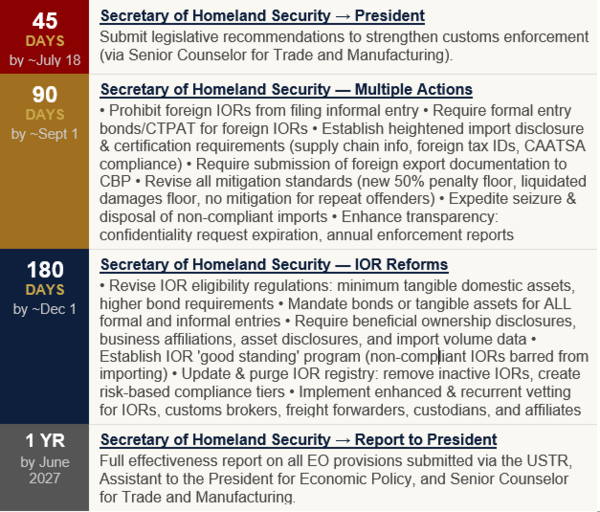
Purpose — Why This EO Exists
Customs reform is described as 'long overdue.' The EO cites systemic loopholes enabling undervaluation, hidden IOR identities, and duty evasion. The stated goals: protect national security, promote lawful trade, ensure timely duty collection, modernize systems, bolster compliance, increase transparency, and protect the domestic economy.
Importers of Record (IOR) Overhaul
The most sweeping section. All IORs must maintain minimum tangible domestic assets and/or bonds. Beneficial ownership, affiliations, and domestic asset disclosures are now required. A new 'good standing' program bars non-compliant IORs from importing. Foreign IORs face the strictest new rules: banned from informal entry; required to use single-transaction bonds (not continuous bonds) or be CTPAT-validated; and required to use a CTPAT-validated customs broker. The IOR registry will be purged and tiered by compliance risk.
Import Disclosure & Certification
New heightened certification requirements include: supply chain and production method details (manufacturer IDs, product specs, composition); foreign tax and global business identifiers; CAATSA compliance certifications; and submission of any documentation the foreign exporter provided to their own customs administration before export. CBP will enforce criminal fines and civil penalties for noncompliance.
Enforcement & Penalties
CBP is directed to enforce liquidated damages on bonds aggressively, restrict in-bond utilization, increase audits, and impose maximum broker penalties for due diligence failures, repeated noncompliant client representation, or failure to timely cooperate with CBP. A 50% minimum penalty floor is established (no mitigation below 50% except in exceptional national security circumstances). Repeat offenders receive zero mitigation. DOJ and DHS must prioritize forced labor, misclassification, undervaluation, and transshipment cases.
Streamlined Disposal
CBP must expedite seizure and disposal of non-compliant goods — reducing barriers to voluntary abandonment, authorizing third-party disposal, and increasing bonds on high-risk shipments.
Definitions — U.S. IOR vs. Foreign IOR
U.S. IOR: Individual who is a U.S. citizen or lawful permanent resident; OR an entity organized under U.S. law, located in the U.S., with controlling beneficial owners who are U.S. citizens/LPRs, or that owns significant U.S. real property. Foreign IOR: Anyone not meeting the above. 'Located in the United States' requires principal place of business in the U.S., physical presence with significant business activity, AND sufficient tangible U.S. assets. Shell companies and sham structures will not qualify.
Foreign-based importers face the biggest changes. If your company is organized or controlled outside the U.S., you will no longer be able to use informal entry (de minimis-style low-value entries). You will also need single-transaction bonds or CTPAT validation — or must use a CTPAT-validated licensed customs broker for your U.S. entries. Plan for these requirements by approximately September 1, 2026
All importers need to prepare for expanded disclosure. CBP will require manufacturer product identifiers, composition details, grade/size specifications, and supply chain documentation going forward. Make sure your suppliers can provide this data.
IOR 'good standing' is now a license to import. If your company has prior customs violations you could be barred from importing. Review your compliance history now.
Beneficial ownership transparency is mandatory. All IORs must disclose ownership and beneficial ownership. Shell company structures will be scrutinized. Ensure your corporate structure is transparent and documentable.
Penalty mitigation is being cut dramatically. The floor is now 50% of any assessed penalty — no more near-full mitigation on first offenses for serious violations. Repeat offenders get zero mitigation.
Signed: June 1, 2026 | Effective: June 8, 2026 | Temporary through: December 31, 2027
President Trump signed a New Proclamation on June 1, 2026 further adjusting the Section 232 tariff regimes on steel, aluminum, and copper products. This builds on Proclamation 11021 (April 2, 2026). Changes take effect June 8, 2026 and are temporary through December 31, 2027, after which rates revert to the standard Proclamation 11021 structure. This newsletter explains each of the 11 proclaimed operative clauses and the six annexes that govern classification and rates.
Rate Structure
Goods containing more than one covered metal are subject to the applicable duty rate only once — rates are not stacked per metal. The highest applicable rate governs. Russia-origin aluminum remains at 200% under Proclamation 10522.
What Are the Annexes?
The Proclamation and HTSUS Chapter 99 use six Annexes to classify products and assign rates. Think of the annexes as tiered product lists: where your HTS number lands determines which rate you pay. Here is what each one means in practice:
50% Rate — Core Metal Articles The master product list of aluminum articles, steel articles, most copper articles, and certain derivatives that are made entirely or almost entirely of covered metals. Products here pay 50% on full customs value. Examples: steel coils, aluminum sheet, copper rod, aluminum extrusions. If a product is in Annex I-A, it is subject to the highest base rate. | |
25% Rate — Substantial Metal Derivatives Products substantially (but not entirely) made of steel, aluminum, or copper. Derivatives that are primarily metal but include other materials. These pay 25% on full customs value. Examples: metal pipe fittings, structural steel components, fabricated aluminum parts, certain copper derivatives not in I-A. | |
15% Transitional Rate — Equipment (NEW — June 8, 2026) Newly created by this proclamation. Lists products qualifying for the temporary 15% rate through December 31, 2027. Includes: agricultural equipment (combines, harvesters), residential HVAC systems and components, fixed industrial machinery and power equipment (from prior Proclamation 11021), and mobile industrial equipment (bulldozers, forklifts) — the last group only when imported from trade-deal-partner countries. After Dec 31, 2027, products revert to Annex I-A or I-B rates. | |
0% / Exempt — Low Metal Content Articles Products containing 15% or less steel, aluminum, or copper by weight are no longer subject to Section 232 tariffs and are listed here as exempt. Importers must report the aggregate weight of applicable metals (in kg) as a second quantity on the entry summary when claiming this exemption under HTS 9903.82.03. Not available for goods classifiable in Chapters 72, 73, 74, or 76. | |
Trade Agreement Partner Exceptions Lists products from qualifying Trade Agreement Partner (TAP) countries that may receive reduced or modified rates, including for manufacturing drawback eligibility. Current TAP countries include the EU member states, UK, Japan, South Korea, Canada, Mexico, and additional reciprocal partners as designated. Products from these countries may be subject to different rate calculations than the standard Annex I-A/I-B rates. | |
HTSUS Chapter 99 Modifications — Implementing Tariff Numbers The technical tariff schedule changes that implement this proclamation in the Harmonized Tariff Schedule (HTSUS). Contains the actual HTS Chapter 99 subheadings (9903.82.xx series) that customs brokers and importers must use when filing entries. Also sets the USMCA duty calculation methodology for Canada/Mexico imports (25% on non-U.S. content with a 15% floor). This annex is the operational filing reference for all covered entries effective June 8, 2026. |
Chapter 99 subheadings (9903.82.xx series) that customs brokers and importers must use when filing entries. Also sets the USMCA duty calculation methodology for Canada/Mexico imports (25% on non-U.S. content with a 15% floor). This annex is the operational filing reference for all covered entries effective June 8, 2026.
What Changed vs. Prior Proclamation 11021 (April 2, 2026)
25% → 15% | Agricultural Equipment Combines, harvesters, and similar ag machinery move from the standard 25% derivative rate into the new Annex I-C at 15%. Previously covered as steel/aluminum derivatives with no rate relief. |
25% → 15% | Residential HVAC Equipment Certain residential heating, air conditioning, and ventilation systems and components now qualify for the 15% transitional rate. |
New — 15%* | Mobile Industrial Equipment Bulldozers, forklifts, and similar mobile industrial equipment are now in Annex I-C at 15%, BUT only when imported from trade-deal countries. Non-trade-deal-country imports remain at 25%. |
95% → 85% | U.S. Domestic Content Threshold The share of U.S.-origin metal needed to qualify for the 10% incentive rate is lowered from 95% to 85% by weight, making the incentive accessible to more products. |
Now Covered | Aluminum Lithographic Plates & Steel Racks These products were previously outside Section 232 coverage. They are now added to Annex I-B as derivative articles, subject to 25%. |
0% | Low Metal Content (≤15%) Products Products containing 15% or less covered metal are fully exempt from Section 232 and move to Annex II. Importers must report metal weight in kg on the entry summary. |
A significant regulatory change that will affect all U.S. importers of regulated consumer products. The U.S. Consumer Product Safety Commission (CPSC) has finalized mandatory electronic filing (eFiling) requirements for Certificates of Compliance, with the deadline fast approaching. Action is required now to ensure your shipments are not delayed or held at U.S. ports of entry.
July 8, 2026 — Mandatory eFiling begins for most imported consumer products
January 8, 2027 — Mandatory eFiling for products entering via Foreign Trade Zones (FTZ)
What Is Changing
On January 8, 2025, the CPSC published a Final Rule in the Federal Register amending 16 CFR Part 1110 — Certificates of Compliance. This rule makes two major changes:
Who Is Affected
This rule applies to importers of consumer products subject to CPSC mandatory safety standards, including but not limited to:
Certificate Types Required
| Certificate Type | Applies To | Testing Requirement |
|---|---|---|
| Children's Product Certificate (CPC) | Products designed primarily for children 12 years old and younger | CPSC-accepted third-party laboratory testing required |
| General Conformity Certificate (GCC) | Regulated general use consumer products subject to CPSC rules | Reasonable testing program as required by CPSC |
Required Action Steps for Importers
We strongly urge you to take the following steps immediately:
Failure to comply with CPSC eFiling requirements may result in:
Official CPSC Resources
CBP has developed the Consolidated Administration and Processing of Entries (CAPE) automated functionality in the Automated Commercial Environment (ACE) to efficiently process IEEPA refunds for Importers of Record (IOR). CAPE is a new ACE functionality that will streamline and consolidate refunds plus interest payments for entries that were subject to IEEPA duties, rather than issuing entry-by-entry refunds.
Phase I of CAPE is scheduled to deploy 8 AM EDT on April 20, 2026. CBP will issue further guidance as additional CAPE functionalities are developed and will maintain all information on IEEPA refunds and CAPE at the IEEPA Duty Refunds webpage on CBP.gov.
Guidance
1.CAPE Tab – ACE Portal
Importers of Record and brokers will have the ability to access the CAPE tab in their ACE portal account. To file a CAPE declaration, the IOR or broker will upload a Comma-Separated Values (CSV) file listing up to 9,999 entry numbers on which IEEPA duties have been paid and for which they are requesting an IEEPA duty refund.
Only entry numbers should be included in the CSV file, and no other entry-related information is needed.
A separate CAPE declaration may be submitted for additional entry numbers beyond the first 9,999. The declaration may only be submitted by the IOR or the broker who had filed the entry summaries. The CAPE Declaration will be available through the “Upload” button in the CAPE tab of the ACE Portal.
The CAPE Declaration and the entry summaries will be validated by ACE before CAPE accepts the file, once accepted it will receive a CAPE claim number. The submission undergoes the following validations:
If any of the above fail validation, ACE will reject the CAPE declaration and filers will be able to see the specific errors that triggered the rejection. Once the errors are identified and corrected, the filer is able to resubmit the Declaration.
Once the submission passes the validation, ACE will run the following validations:
If any of the above validations fail, the entry summary will be removed from the CAPE declaration but will continue to validate the remaining error free entry summaries. After the system completes the validation process, ACE will display the results and identify any rejected entries and the reason for the rejection. If the filer corrects the entry errors identified, they may resubmit the entry summary on a separate CAPE declaration. After the validations are performed the CAPE Declaration is submitted and assigned a unique CAPE claim number.
For more information on the CAPE filing process, please visit CAPE Declaration Quick Reference Guide
2. Mass Processing
Mass processing will be performed on all entry summaries that were accepted. All applicable IEEPA HTSUS Chapter 99 numbers will be removed, the duties owed will be recalculated as if IEEPA duties were never owed. The refund will be the difference between duties, taxes, fees paid on the entry summaries and the recalculated duties, taxes and fees. Interest will be calculated on these refunds.
3. Review and Liquidation/Reliquidation
Once the mass processing is completed, unliquidated entries will be set to liquidate 45 days from the CAPE declaration acceptance date, except for entries in suspended, extended or “under review” status – these entries will maintain their original or current liquidation status and the refund will be issued upon liquidation .
Warehouse and warehouse withdrawal entry summaries will liquidate in the normal course after all withdrawals have ben made and the entry is ready for liquidation.
Liquidated entries will reliquidate the next business day.
4. Refund
The entry summary refunds will be consolidated by IOR or designated 4811 party and liquidated date before they are dispersed in one lump sum.
ACE portal users may monitor the refund information using the new ACE REV-615 Trade Report.
For unliquidated entries, with some exceptions, the importers and brokers may anticipate the IEEPA refunds to be issued within 60-90 days following the acceptance of a CAPE Declaration.
5. Additional Information
If a protest has been submitted solely for IEEPA refund purposes and the entry summary is within 80 days of liquidation, an importer may withdraw the protest and add the entry summary to the CAPE declaration for a faster refund processing.
A Post Summary Correction (PSC) will not be accepted for an IEEPA refund.
Liquidation dates are a moving target and while Phase I does include certain liquidated entries, it is important to understand that liquidation dates are being updated on a daily basis and protests still remain a critical safeguard to protect your rights to a IEEPA duty refund. We are able to assist in monitoring of liquidation dates and are actively working to support our clients through this process.
To learn more about the CAPE functionality, please see the CAPE Information Notice.
Technical questions may be directed to IEEPARefunds cbp.dhs.gov. General questions may be directed to traderelationscbp.dhs.gov.
President Trump signed an executive order that will impose Section 232 duties on certain pharmaceuticals products. Per fact sheet, these tariffs will take effect in 120 days for certain large companies and in 180 days for smaller companies.
Updated changes are as follows:
On April 2, 2026, the White House issued a proclamation updating the Section 232 tariffs applied to steel, aluminum and copper goods.
Effective Monday April 6, 2026, goods entered for consumption or withdrawn from warehouse for consumption on or after 12:01 a.m. EDT will be subject to these revised rates. There will be no longer a division between metal and non-metal content for derivative items, instead the tariff will apply to the full declared value of the article.
Updated changes are as follows:
CSMS# 67270895 – Electronic Refunds Interim Final Rule Effective February 6, 2026
Effective February 6, 2026, U.S. Customs and Border Protection (CBP) will issue refunds exclusively through electronic payments via Automated Clearing House (ACH). This change applies to all refunds, subject to limited exceptions, such as certain emergency payments, transactions involving national security or law enforcement concerns, and situations involving individuals without access to banking or electronic payment systems, please see Federal Document 2025-24171.
The rule applies to all importers, customs brokers, filers, sureties, service providers, facility operators, foreign trade zone operators, carriers, and any designated third parties listed on the CBP Form 4811. Absent an approved waiver, CBP will no longer issue refund checks after February 5, 2026.
In regard to the IEEPA duties, CBP has confirmed that it is currently developing a new functionality within ACE to process the court-ordered IEEFA tariffs refunds within approximately 45 days. Once this system enhancement is implemented, importers will be required to submit an ACE declaration identifying the entries on which IEEPA duties were paid, after which CBP will validate the entries, recalculate duties and process the applicable refunds with interest.
To receive refunds via ACH, importers must enroll and manage payment information through CBP’s Automated Commercial Environment (ACE) Secure Data Portal.
As a first step, please ask your broker to complete a CBP Form 5106 add or update – 5106 update includes the full name, phone number, email and title of the ACE account owner. Once 5106 has been added or updated, please wait until the following business day before applying for ACE access.
To apply for an ACE account please use the links below:
Once the ACE portal is active, update the Refund Tab with banking information so any refunds will be received automatically via ACH.
Please read CBP’s fact sheet here about ACE Portal application.
The U.S. Court of International Trade (CIT) issued an order instructing Customs and Border Protection (CBP) to liquidate unliquidated import entries without regard to IEEPA duties and to reliquidate any entries that have been liquidated but are not yet final.
If the entry is not liquidated yet, CBP is ordered to remove the IEEPA duty before finalizing it and liquidating it. Customs is not to lock the illegal IEEPA tariffs into liquidation. A huge number of entries are still not liquidated so those may now be resolved automatically as they liquidate, without protests, without lawsuits.
However, this order is expected to be appealed because of the procedural deficiencies with the order and due to the universality of it, amongst other concerns.
GW compliance team does recommend filling protests against already liquidated entries in order to preserve the right to the potential refund. Protests must be filed within 180 days after the date of liquidation. No extensions are permitted.
A reminder, that effective February 6, 2026 CBP refunds are being issued electronically via ACH. Each importer needs an ACE account in order to access the new ACH Refund Authorization tool. Please review the CBP’s Electronic Refund Enrollment Reference Sheet.
Customs and Border Protection (CBP) provided guidance to the trade regarding its discontinuation of collecting IEEPA tariffs effective 12:00 a.m. ET on Feb. 24 in response to Feb. 20 Executive Order (EO), “Ending Certain Tariff Actions.”
Guidance – Ending IEEPA Tariff Collection
Duties imposed pursuant to IEEPA under the following presidential actions, including all modification and amendments, will no longer be in effect and will no longer be collected for goods entered for consumption or withdrawn from warehouse for consumption, on or after 12:00 a.m. ET on Feb. 24, 2026:
CBP said it will update ACE programming and all HTSUS numbers applicable to the IEEPA tariffs will be inactive in ACE as of Feb. 24, 2026.
In response to the Supreme Court decision ending the IEEPA tariffs, President Trump issued a proclamation which imposes for a period of 150 days a 10% ad valorem import duty under Section 122 of the 1974 Trade Act on articles imported into U.S. The temporary import duty will take effect at 12:01 a.m. ET on Feb. 24.
CBP has not issued and guidance in regards to any refunds of the IEEPA tariffs.
We will provide tariff updates as they become available.
President Trump in a Truth Social post this morning, February 21, said he will now increase the 10% ad valorem import duty under Section 122 of the 1974 Trade Act on all articles imported into the U.S. over the next 150 days to the maximum 15% tariff.
On Friday, February 20, the president announced that he will implement a 10% global tariff under Section 122 in response to the U.S. Supreme Court’s decision which struck down the Trump administration’s use of IEEPA tariffs. The Section 232 and 301 tariffs will remain in place, he added.
We will provide tariff updates as they become available.
On February 20, 2026, the U.S. Supreme Court has issued a decision regarding the use of the International Emergency Economic Powers Act (IEEPA) as legal authority for certain tariffs. In a 6–3 ruling, the Court determined that IEEPA cannot be used as the basis for imposing specific tariff measures.
This decision does not affect all existing tariffs. Duties imposed under other legal authorities, including Section 232 (steel and aluminum) and Section 301 tariffs, remain in effect.
At this stage, it remains unclear whether importers may be eligible for duty refunds related to affected tariffs.
We will closely monitor any further developments. The full text of the decision can be found here.
Under the agreement, which was signed on February 12, Taiwan will eliminate or reduce 99% of tariff barrier on U.S. goods and provide preferential market access for U.S. industrial exports, including autos and auto parts, chemicals, seafood, machinery, health products, electrical products, metals, and minerals.
Taiwan will also provide preferential market access for U.S. agricultural exports, including horticultural products, wheat, beef and beef products, dairy products, pork and pork products, lamb and sheep meat, tree nuts, dog and cat food, ketchup, and peanuts. In addition, the country has committed to resolving non-tariff barriers affecting U.S. exports of motor vehicles, medical devices, and pharmaceuticals.
The U.S. will also apply the higher of either the U.S. Most Favored Nation (MFN) tariff rate or a tariff rate of 15%, comprised of the MFN tariff and a reciprocal tariff within the meaning of the April 2, 2025 Executive Order 14257, as amended.
You can read the factsheet on the agreement here.
President Trump issued an Executive Order evening of January 29, stating an additional ad valorem duty may be imposed on goods imported into U.S. which are products of a country that directly or indirectly sells or otherwise provides an oil to Cuba, effective 12:01 a.m. ET on January 30.
The president cited IEEPA for the reason to impose tariff, adding that Cuba imposes a national security risk to the U.S.
The exact tariff amounts have not been yet announced by the administration. However, the EO authorizes the secretaries of State and Commerce to “take all necessary actions, including issuing rules and guidance, to implement the tariff system and related measures.”
The EO fact sheet said that the president may modify the tariff conditions if Cuba or affected countries retaliate against the United States in response to this order or any action taken pursuant to this order.
We will provide tariff updates as they become available.
The White House factsheet regarding this EO is available here.
Under the U.S.-Bangladesh Agreement on Reciprocal Trade, which was signed on Monday, January 9, the U.S. will maintain a 19% reciprocal tariff rate for imports from Bangladesh except for identified products from the list set out in Annex III. The tariff scheduled related to this agreement is available here.
Bangladesh agreed to provide preferential market access for U.S. industrial and agricultural goods, including chemicals, machinery and parts, medical devices, motor vehicles and parts, information and communication technology equipment, energy products, soy products, dairy products, beef, poultry, and tree number and fruit.
In addition, Bangladesh committed to address non-tariff barriers that affect bilateral trade and investment in priority areas, including accepting vehicles built to U.S. federal motor vehicle safety and emissions standards; accepting U.S. Food and Drug Administration (FDA) certificates on prior marketing authorizations for medical devices and pharmaceuticals; and removing any import restrictions or licensing requirements on U.S. remanufactured goods or their parts.
Lastly, Bangladesh has committed to address and prevent barriers to U.S. agricultural exports in its market, including by accepting certificates issued by U.S. regulatory authorities and recognizing U.S. sanitary and phytosanitary measures and other measures for food and agricultural products
CSMS# 66027027 CBP Updates Guidance Modifying Additional Duties on Imports from India
Issued on February 6, 2026, CSMS message 66027027 provides guidance regarding implementation of the Presidential Executive Order on imports of products of India.
Guidance
Products of India entered for consumption or withdrawn from warehouse for consumption on or after 12:01 am easer time on February 7, 2026 are no longer subject to the additional ad valorem duty rate of 25 percent imposed by Executive Order 14329, “Addressing Threats to the United States by the Government of the Russian Federation” signed on August 6, 2025 – also referred as the Russian Oil Tariff.
As a results, HTSUS headings 9903.01.84 – 9903.01.89 are no longer in use as of February 7, 2026.
The IEEPA reciprocal tariff for India 9903.02.26 @ 25% remains in effect for products of India and do not qualify for an exemption.
On February 3, 2026, the President extended duty free treatment through December 31, 2026, for imports from eligible AGOA beneficiary countries and select imports from Haiti under the HOPE and HELP programs, for imports entered or withdrawn from warehouse for consumptions.
This also provides retroactive duty refunds (without interest) of ad valorem duties paid on eligible imports entered or withdraw from warehouse for consumption during the lapse of these programs from October 01, 2025, through February 3, 2026. Retroactive duty refunds are applicable only to the general ad valorem duties paid during the lapse. Refunds are not available for merchandise processing fees (MPF), IEEPA/Reciprocal duties or any other type of duties.
This guidance is to also inform the Trade that effective Friday February 6, 2026 importers may resume filling special program indicated SPI “D” to receive preferential benefits on the AGOA-eligible goods and effective Monday February 9, 2026 importer may resume claiming preferential benefits on applicable imports under the reestablished quota programs for eligible imports from AGOA beneficiary countries and Haiti.
More than 1,000 companies have recently filed suit at the U.S. Court of International Trade in advance of the Supreme Court decision to address the IEEPA tariff refunds process, while many more have begun filling protests with CBP to preserve their administrative right if necessary to obtain refunds.
Here are some updates to be aware of:
CSMS# 67270895 – Electronic Refunds Interim Final Rule Effective February 6, 2026
Effective February 6, 2026, U.S. Customs and Border Protection (CBP) will issue refunds exclusively through electronic payments via Automated Clearing House (ACH). This change applies to all refunds, subject to limited exceptions, such as certain emergency payments, transactions involving national security or law enforcement concerns, and situations involving individuals without access to banking or electronic payment systems, please see Federal Document 2025-24171.
The rule applies to all importers, customs brokers, filers, sureties, service providers, facility operators, foreign trade zone operators, carriers, and any designated third parties listed on the CBP Form 4811. Absent an approved waiver, CBP will no longer issue refund checks after February 5, 2026.
To receive refunds via ACH, importers must enroll and manage payment information through CBP’s Automated Commercial Environment (ACE) Secure Data Portal.
This rule will require trade members to set up ACE Portal accounts and to submit ACH banking information so that CBP can issue ACH refunds instead of mailing refunds as checks.
Importers without a U.S. bank account must either open a U.S. bank account or designate your customs broker with a U.S. bank account consistent with 31 U.S.C. 3332(g).
Failure to provide CBP with the ACH banking information will result in a rejected refund; for rejected refunds, an importer must complete an ACH Refund application and email frn-achrefundsupportcbp.dhs.gov.
Please read CBP’s fact sheet here.
Customs and Border Protection has provided the trade with detailed guidance on the implementation of the January 14 Proclamation, “Adjusting Imports of Semiconductors, Semiconductor Manufacturing Equipment, and Their Derivative Products into the United States.”
The January 14, Proclamation issued pursuant to Section 232 of the 1962 Trade Expansion Act, as amended ( 19 U.S.C. 1862), imposes 25% ad valorem duties on certain imports of semiconductors and their derivative products.
Entry Filling Guidance:
Entries covering certain imported semiconductors and their derivative products from all countries, as provided in the below headings of the HTSUS, entered for consumption, or withdrawn from warehouse for consumption, on or after 12:01 a.m. ET on Jan. 15, 2026:
Subheadings:
8471.50
8471.80
8473.30
The imported products must be a logic integrated circuit, or an article that contains a logic integrated circuit, that meets the technical parameters of having:
(1) a total processing performance (TPP) greater than 14,000 and less than 17,500, and a total DRAM bandwidth greater than 4,500 GB/s and less than 5,000 GB/s; or
(2) a TPP greater than 20,800 and less than 21,100, and total DRAM bandwidth greater than 5,800 GB/s and less than 6,200 GB/s.
25% additional ad valorem duty
Exclusions – 0% additional ad valorem duty
Entries paying Section 232 duties for Semiconductors are NOT subject to:
The Commerce Department announced on January 15, that it has reached an agreement with Taiwan to expand market access for U.S. companies in the Taiwanese semiconductor, AI, defense technology, telecommunications, and biotechnology industries.
In response, the U.S. reciprocal tariff rate for Taiwanese goods will total no more than 15% and the Section 232 duties applied to Taiwanese auto parts, timber, lumber, and wood derivative products will total no more than 15%.
The U.S. will also apply 0% reciprocal tariff for generic pharmaceuticals, their generic ingredients, aircraft component and unavailable natural resources.
The information contained in this document is intended to convey general information only and does not constitute legal advice or opinions. The contents of this document should not be relied upon for legal advice and Gebruder Weiss disclaims all liability in respect to actions taken or not taken based on any or all of the contents of this document to the fullest extent permitted by law. A trade attorney should be contacted for advice on any legal issues.
Has CBP issued binding legal advice regarding the valuation of the metal content?
Despite the requirements that Section 232 duties are assessed based on the value of the steel and aluminum content of the subject of the goods, CBP still has not published binding, formal legal guidance for calculating the value.
What are the main concerns regarding the valuation of metal content?
What guidance has CBP provided at this time?
“The value of the steel/aluminum content should be determined in accordance with the principles of the Customs Valuation Agreement, as implemented in 19 U.S.C. 1401a. Thus, the value of the steel/aluminum content is the total price paid or payable for that content, which is the total payment (direct or indirect, and exclusive of any costs, charges, or expenses incurred for transportation, insurance, and related services incident to the international shipment of the merchandise from the country of exportation to the country of importation) made/to be made for the steel/aluminum content by the buyer to, or for the benefit of, the seller of the steel/aluminum content. Normally, this would be based on the invoice paid by the buyer of the steel/aluminum content to, or for the benefit of the seller of the steel/aluminum content.”
Has CBP provided any additional or differing guidance?
CBP’s Base Metals Center of Excellence and Expertise recently provided informal guidance, which now has been included in the CBP Notices of Action advising importers that:
How does the CEE Base Metal’s guidance impact the valuation of the metal content for section 232 and non-metal content for IEEPA purposes?
The Base Metal Center interpreted the HQ’s FAQ that the value of the steel/aluminum content should be based on the declared entered value of the merchandise, pro-rated as necessary to exclude the value/cost of the non-steel/aluminum parts/components of the finished article. “CBP has not posted any new guidance recently, but continue to monitor the CSMC message, Trade Remedy FAQs, and CBP rulings posted on cbp.gov.”
What documentation is needed to support metal content valuation?
CBP has issued CBPF-28s asking for: calculation method, detail explanation, cost analysis, responsible party, importer awareness, supporting documentation, invoices and packing lists, schematics/diagrams, and photographs. CBP will be looking for actual steel and aluminum value and based on these CBP guidance letters and notices of action advising importers. This reinforces the need for documentation to demonstrate the actual costs.
In Summary:
Until CBP HQ publishes definitive guidance or issues a legally biding ruling or decision, the most conservative approach, and the one which would not be questioned as a lack of reasonable care is to follow the Base Meal Center’s interpretation methodology and prorate the total steel/aluminum content value including processing, fabrication, etc. from the total entered value of the finished article.
For further information, refer to the CBP Metals Base Center guidance regarding Section 232 content value and example questions found in CF 28 and CF29 issued by CBP.
The Office of the U.S. Trade Representative (USTR) on December 17, published a Federal Notice stating that the reduction in the reciprocal tariff goods from Switzerland and Liechtenstein are retroactive to 12:01 a.m. ET Nov. 14.
On Nov. 14, 2025, the U.S., Switzerland, and Liechtenstein announced a framework to negotiate an agreement on fair, balanced and reciprocal trade, and agreed to modification of certain tariff rates.
Some of the key highlights are outlined below:
More details are available in the USTR Federal Notice here.
See the Annex 1 and 2 changes in the Federal Notice here.
The Office of the U.S. Trade Representative (USTR) announced on Dec.10, 2025, the authorization of Section 301 tariffs on Nicaragua products, excluding those originating under the Dominican Republic-Central America-United States Free Trade Agreement (CAFTA-DR), citing the country’s continued human rights abuses and disregard of the rule of law.
The tariff will be set at 0% on Jan.1, 2026, and will increase to 10% on Jan.1, 2027, and to 15% on Jan.1, 2028. Any tariff would stack with others such as the existing IEEPA Reciprocal Tariff that is currently 18%.
This timeline and rates may be modified, and GW will be monitoring any changes.
The Federal Register notice is available here, while the copy of the Oct.20, 2025 USTR Report can be reviewed here.
The Office of the U.S. Trade Representative (USTR) on December 3, published a Federal Notice confirming tariff changes resulting from a agreement reached between U.S. and South Korea outlined in a fact sheet. These changes apply retroactively from Nov. 1,2025 for automobile and auto parts and Nov. 14,2025 for other product imports.
Some of the key highlights are outlined below:
Section 232 tariffs of 50% will remain in place for steel, aluminum and copper.
More details are available in the USTR Federal Notice.
President Trump released an Executive Order on Nov. 14, which effectively ends reciprocal tariffs for certain agricultural product imports. The order took effect for these now exempted goods entered into consumption, or withdrawn from warehouse for consumption, at 12:01 a.m. ET on Thursday Nov. 13.
The Annex with the Executive Order provides details regarding the applicable HTS numbers for the agriculture products covered. Apart from the products listed below, all other products on the Annex are exempt from reciprocal tariffs by subheading 9903.01.32. The newly added agriculture products noted below which are described in the Annex I subdivision (iii)(b) to U.S. note 2(v) to subchapter 99 of the HTSUS will be exempted from reciprocal tariffs by subheading 9903.02.78.
1. Etrogs (classifiable in subheading 0805.90.01)
2. Tropical fruit, nesoi, frozen, whether or not previously steamed or boiled (classifiable in subheading 0811.90.80)
3. Date palm branches, Myrtus branches, or other vegetable material for religious purposes only (classifiable in subheading 1404.90.90)
4. Bread, pastry, cakes, biscuits and similar baked products, nesoi, and puddings, whether or not containing chocolate, fruit, nuts or confectionery, for religious purposes only (classifiable in subheading 1905.90.10)
5. Bakers’ wares, communion wafers, empty capsules suitable for pharmaceutical use, sealing wafers, rice paper and similar products, nesoi, for religious purposes only (classifiable in subheading 1905.90.90)
6. Acai (classifiable in subheading 2008.99.21)
7. Citrus juice of any single citrus fruit (other than orange, grapefruit or lime), of a Brix value not exceeding 20, concentrated, unfermented, except for lemon juice (classifiable in subheading 2009.31.60)
8. Coconut water or juice of acai (classifiable in subheading 2009.89.70)
9. Coconut water (classifiable in subheading 2009.90.40)
10. Acai preparations for the manufacture of beverages (classifiable in subheading 2106.90.99)
11. Essential oils other than those of citrus fruit, other, nesoi, for religious purposes only (classifiable in subheading 3301.29.51)
Over the weekend, The White House released a fact sheet outlining a new trade agreement with China.
The agreement includes a wide range of measures impacting tariffs, export controls, agriculture trade, and supply chain operations between the two nations.
Key Points – U.S. Actions:
Key Points – China’s Actions:
To view the full White House fact sheet, click here.
President announced the implementation of Section 232 tariffs on imports of medium, heavy-duty vehicles and parts and buses to take effect on 12:01 a.m. ET on November 1, 2025.
The rates of duty established in this proclamation shall apply with respect to goods entered for consumption, or withdrawn from warehouse for consumption, on or after 12:01 a.m. ET on Nov.1st. There is no in-transit exemption available.
The tariffs include:
Read the entire proclamation for more details along with the new annex listing of the tariff subheadings subject to the increased tariffs.
Products subject to these tariffs under this proclamation will not be subject to additional tariffs under Section 232 iron, steel, aluminum, copper, autos, auto parts, and lumber. Also, will not be subject to IEEPA reciprocal tariff, Brazil Additional tariff or India Russian Oil tariff.
Customs and Border Protection (CBP) issued guidance for implementing Section 232 measures on imports of timber, lumber, and related products.
These measures apply to goods entered for consumption, or withdrawn from warehouse for consumption, on or after 12:01 a.m. ET on October 14, 2025.
Softwood Timber and Lumber (9903.76.01)
Applies to imports of softwood timber and lumber products from all countries under specified HTSUS subheadings.
10% additional duty applies to the following:
4403.11.00, 4403.21.01, 4403.22.01, 4403.23.01, 4403.24.01, 4403.25.01, 4403.26.01, 4403.99.01, 4406.11.00, 4406.91.00, 4407.11.00, 4407.12.00, 4407.13.00, 4407.14.00, 4407.19.00.
Upholstered Furniture (9903.76.02)
Excludes U.S., United Kingdom, Japan, and E.U.
25% additional duty
Applies to imports from all other countries classified under HTSUS 9401.61.4011, 9401.61.4031, 9401.61.6011, 9401.61.6031.
Completed Kitchen Cabinets, Vanities, and Parts (9903.76.03)
Excludes U.S., United Kingdom, Japan, and E.U.
25% additional duty
Applies to HTSUS 9403.40.9060, 9403.60.8093, 9403.91.0080.
Other Non-Completed Products (9903.76.04)
For imports classified under the same headings but not representing completed cabinets, vanities, or parts.
0% additional duty.
Products from the United Kingdom, Japan, and the European Union
Exemptions
Annex II Update
Certain products will be removed from Annex II under exemption 9903.01.32 and will no longer qualify for that exemption. Please check the latest version when it gets updated and reach out to your assigned Gebrüder Weiss representative to confirm any details.
The U.S. government announced new Section 232 tariffs on lumber, kitchen cabinets, vanities, and other wood products. These measures will take effect at 12:01 a.m. ET on October 14, 2025.
Key points:
The Section 232 tariffs on subject wood imports from the United Kingdom will not exceed 10%, while the combined Section 232 tariff will not exceed 15% on imports from the European Union and Japan.
According to the White House, trading partners who negotiate with the U.S. to address the threat of wood imports to the national security of the U.S. may be able to secure an alternative to the pending tariffs increases.
Read the entire proclamation for more details along with the new annex listing of the tariff subheadings subject to the increased tariffs.
On September 30, U.S. Customs and Border Protection (CBP) will update the ACE Secure Data Portal to enable electronic refund transactions, in accordance with Executive Order 14247.
This update allows authorized trade users to provide U.S. bank information directly in the ACE Portal, facilitating refunds via Automated Clearing House (ACH). CBP emphasized that this is a preparatory step and that paper refund checks will continue to be issued until a future transition to electronic-only refunds is announced.
CBP also announced these changes in the Federal Register: New Functionality Pertaining to Electronic Refunds in the Automated Commercial Environment on September 24. With this notice, CBP is making the availability of electronic refunds via ACH more accessible by deploying a new functionality, the ACH Refund Authorization tab, in the ACE portal.
Importers are encouraged to obtain an ACE portal account or otherwise if they cannot access the ACE Refund Authorization tab via the ACE Portal, the individual or entity may submit an ACH Refunds Enrollment Form for manual processing. Download Form here
Please reach out to your assigned Gebrüder Weiss representative with any questions regarding ACE Portal access or ACH Refunds Form.
On September 25, the U.S. Government announced new tariffs on imports of pharmaceuticals, furniture, and heavy trucks, effective October 1.
We will keep you informed on further developments.
Customs and Border Protection (CBP) issued guidance regarding Executive Order 14345, “Implementing the United States – Japan Agreement.”
Under the agreement, the U.S. will apply a baseline 15% tariff on nearly all Japanese imports entering the U.S., with sector-specific provisions for automobiles, automobile parts, and aerospace products.
CBP advised that these measures apply to Japanese products entered for consumption, or withdrawn from warehouse for consumption, on or after 12:01 a.m. ET on August 7, 2025. Effective September 16, tariff heading 9903.02.30 will no longer be active.
IEEPA Reciprocal Tariff Guidance:
Civil Aircraft Tariff Guidance
Products of Japan that fall under the WTO Agreement on Trade in Civil Aircraft, except for unmanned aircraft, are no longer subject to additional tariffs imposed through IEEPA reciprocal tariff, Section 232 for aluminum, steel and copper.
Automobile and Automobile Parts Tariff Guidance
EO 14345 modifies Section 232 duties on passenger vehicles and light trucks and automobile parts that are products of Japan that are entered for consumption or withdrawn from warehouse on or after 12:01 a.m. ET on Sep. 16.
Automobiles Tariffs
Automobile Parts:
Product Subject to Section 232 Tariff Guidance
All products of Japan that are subject to Section 232 action will be exempt from IEEPA Reciprocal tariffs under exemption heading 9903.01.33. These Section 232 actions include:
Please reach out to your assigned Gebrüder Weiss representative should you have any questions or concerns.
In a judgment issued on Tuesday, September 2nd, the U.S. Court of Appeals for the Federal Circuit (CAFC) ruled that most of President Donald Trump’s global tariffs are illegal as they exceed the authority granted under the International Emergency Economic Powers Act (IEEPA).
The full text of the opinion is available here.
The CAFC affirmed the decision by the Court of International Trade (CIT) declaring the “Trafficking and Reciprocal Tariffs” invalid as contrary to law and upheld the grant of declaratory relief. The panel vacated the CIT’s permanent injunction, remanding the case back to the lower court for reevaluation.
The Trump Administration has formally appealed the Federal Circuit ruling that struck down tariffs imposed under the IEEPA. In its motion, the government warned that the decision threatens ongoing trade negotiations and risks significant economic disruption if left unresolved.
The Supreme Court has been asked to expedite the review, with a decision on the review by September 10th, briefs through October, and oral arguments scheduled for the first week of November.
Until the Supreme Court rules, the tariffs will remain in place. We will continue to monitor these developments as they progress.
Please reach out to your assigned Gebrüder Weiss representative should you have any questions or concerns.
Customs and Border Protection (CBP) released updated guidance under Executive Order 14257, as amended by the September 5th order “Modifying the Scope of Reciprocal Tariffs and Establishing Procedures for Implementing Trade and Security Agreements.”
The update provides an expanded list of products exempted from IEEPA reciprocal tariffs.
Key Highlights:
Updated Annex II & III List Link
Please reach out to your assigned Gebrüder Weiss representative should you have any questions or concerns
President Trump, on Thursday evening, September 4th, signed an Executive Order to implement a trade agreement between the U.S. and Japan.
Under the Agreement, the U.S. will apply a baseline 15% tariff on nearly all Japanese imports entering the U.S. alongside separate sector-specific treatment for automobiles and automobile parts; aerospace products; generic pharmaceuticals; and natural resources that are not naturally available or produced in the U.S.
The tariffs set forth shall apply retroactively to products of Japan entered for consumption or withdrawn from a warehouse for consumption on or after 12:01 a.m. ET on August 7th, 2025. Any refunds shall be processed pursuant to applicable laws and U.S Customs and Border Protection standard procedures for such refunds.
Within seven days of this notice, the Commerce Secretary will publish a notice in the Federal Register modifying the Harmonized Tariff Schedule of the United States that will be consistent with this order.
We will continue to monitor this update and inform our clients accordingly.
Please reach out to your assigned Gebrüder Weiss representative should you have any questions or concerns.
The Commerce Department announced in a press release on Aug. 19, that 407 product categories were added to the list of “derivative” steel and aluminum products covered by Section 232 tariffs. The steel and aluminum content of these products will be subject to a duty rate of 50%.
Aluminum and steel products included on the list from the UK are subject to 25% duty on the value of the metal content, and aluminum and steel products included on the list from Russia are subject to a duty rate of 200%.
Effective 12:01 a.m. ET Aug.18, in accordance with “Adoption and Procedures of the Section 232 Steel and Aluminum Tarif Inclusions Process” the Commerce Department added additional derivative products to Annex I of the HTSUS to be subject to Section 232 duties.
Consult the Section 232 Tariffs on Steel and Aluminum FAQs page for additional guidance – including on reporting country of melt and pour, determining the value of steel content and reporting requirements on goods subject to both steel and aluminum duties.
For reference, a summary of the updated Section 232 Chapter HTSUS classification list is attached at the bottom of the CSMS# 65936570 for steel here and CSMS# 65936615 for aluminum here.
Customs and Border Protection on Monday evening, Aug. 11th, released guidance to a trade implementing the Aug.11th Presidential Executive Order “Further Modifying Reciprocal Tariff Rate to Reflect Ongoing Discussions with the People’s Republic of China.”
Hours before the trade truce between China and the U.S. was set to expire, President Trump announced a 90-day extension, that will keep the current trade truce in place until 12:01 am ET November 10th.
9903.01.63 will remain suspended and covered products imported from China, Hong Kong and Macau, that are entered for consumption or withdrawn from warehouse for consumption prior to 12:01 a.m. ET on Nov. 10 will continue to be subject to the reciprocal tariff 9903.01.25 @ 10% ad valorem duty.
9903.01.25: Articles the product of any country, except for products described in headings 9903.01.26–9903.01.33, 9903.02.02–9903.02.71, and 9903.96.01, and except as provided for in headings 9903.01.34 and 9903.02.01, as provided for in subdivision (v) of U.S. note 2 to this subchapter, will be assessed an additional ad valorem duty rate of 10%.
All other applicable tariffs will remain to be assessed in addition to the reciprocal tariff, such as IEEPA Fentanyl, Section 301 and Section 232.
On August 6th President Trump issued an Executive Order citing IEEPA authority imposing an additional 25% tariff on India because of it imports of Russian oil and oil products. While now it is only India, we do not know if additional countries may be subject as well.
It is important to note that this is not an increase to the IEEPA reciprocal tariff for India under 9903.02.26 @ 25%. This is a separate tariff imposed under IEEPA to address the imports of Russian oil, as such this will be referred to as the IEEPA Russian Oil tariff.
Rate: 25% ad valorem IEEPA Russian Oil tariff
Effective Date: Effective 12:01 am ET on Aug. 27, 2025
Stackability: IEEPA Reciprocal tariff 25% in addition to IEEPA Russian Oil tariff 25%
Exceptions:
Additional Duties on Imports from Canada
Pursuant to Executive Order 14193, issued on February 1st, 2025, was amended by Executive Order, “Amendment to Duties to Address the Flow of Illicit Drugs Across Our Norther Border” issued on July 31, 2025 with below updated guidance on additional duties due on imports that are the products of Canada.
For goods that are products of Canada, that are entered for consumption or withdrawn from warehouse for consumption, on or after 12:01 am eastern daylight time on August 1, 2025, the following duty rates will apply:
Canada IEEPA Fentanyl 9903.01.10: All imports of articles that are products of Canada, other than products under headings 9903.01.12-9903.01.15 and other than products for personal use included in accompanied baggage of persons arriving in the United States – will be assessed an additional duty of 35%.
Goods that qualify for preferential treatment under USMCA will be excluded from the imposition of the 35%.
No updates on IEEPA Reciprocal duties CSMS# 64680374 guidance dated 04/08/2025 – the Executive Order advises to use tariff 9903.01.26 to exclude Canada from Reciprocal duties. An updated will be provided if that changes.
Extension of Trade Talks with Mexico
On July 31, 2025, President Trump announced that trade talks between U.S. and Mexico will be extended for 90 days, past the original Aug. 1st deadline for 30% tariff to take effect.
For the 90-day period, Mexico will continue to pay a 25% Fentanyl Tariff, 25% Tariff on Cars, and 50% Tariffs on Steel, Aluminum, and Copper.
Goods qualifying for preferential treatment under USMCA will continue to be excluded and not subject to the IEEPA Mexico Tariffs.
President Trump issued an Executive Order on July 31, 2025, which sets in motion the imposition of reciprocal tariffs on most countries which have not reached trade deals with the U.S.
The tariffs because effective for goods entered for consumption or withdrawn from warehouse for consumption, on or after 12:01 a.m. Aug. 7th. Except for goods that were loaded onto a vessel at the port of loading and in transit on the final mode of transit before 12:01 a.m. ET Aug. 7th and entered for consumption, or withdrawn from warehouse for consumption, before 12:01 a.m. ET on Oct. 5, 2025.
Application of tariffs by individual country: Download PDF File
In accordance with the International Emergency Economic Powers Act (IEEPA) and the Executive Order issued on July 30, 2025, the following guidance outlines new duties imposed on imports originating from Brazil.
Effective 12:01 a.m. Eastern Daylight Time (EDT) on August 6, 2025, certain Brazilian-origin products entered for consumption or withdrawn from warehouse for consumption will be subject to an additional 40% duty, in addition to existing tariffs. This change will bring the total duty rate on most Brazilian imports to 50%.
HTS Code 9903.01.77:
All imports of products from Brazil, except those classified under 9903.01.78–9903.01.83, and personal-use goods included in accompanied baggage of persons arriving in the U.S., will be assessed an additional 40% duty.
Additional duty of 40% in 9903.01.77 applies in addition to the IEEPA Reciprocal tariff in 9903.02.09 of 10%, including antidumping/countervailing, taxes, duties, and other charges. The additional duty provided in 9903.01.77 does not apply to products of Brazil subject to Section 232 duties.
Exceptions include:
On July 28th President Trump announced a Trade Deal with The European Union (EU), fundamentally rebalancing the economic relationship between the two largest economies.
Some of the key highlights from the document include the following commitments: